CanopyFind

Emergency Tree Service in Cartersville, GA

For an emergency tree service request in Cartersville, start with the local rule, the tree and site conditions, and the exact scope you want a provider to evaluate. The sections below combine Cartersville-specific context with practical emergency tree service guidance.

Keep a safe distance from unstable trees and hanging limbs.

If a line may be energized, contact the utility or emergency services first.

worker clearing heavy fallen tree branches after storm damage

Start your emergency tree service request

Choose the tree work that applies and tell us where the property is. You can add details in the next step.

Services Select all that apply

Submitting a service request does not book a job.

Emergency Tree Service in Cartersville: local factors first

Routine residential emergency tree work in Cartersville is not delayed by a city tree-removal permit requirement. Larger lots and rural-fringe properties can change access and travel considerations, while the city remains exposed to the broader Georgia tornado and severe-wind pattern.

How to frame tree removal in Cartersville

In Cartersville, a useful removal estimate should describe the whole operation: how the tree will be dismantled, what happens to brush and trunk sections, how nearby property will be protected, and whether stump grinding is part of the price. Open yards and constrained backyards can require very different methods even for trees of similar size. Homeowners should separate hazard indicators from appearance concerns. Extensive dead crown, major cracks or cavities, lifting roots, serious lean, and advanced decline are stronger removal signals than ordinary deadwood or an oversized crown. For ash trees showing Emerald Ash Borer attack, the Georgia Forestry Commission's guidance supports removal after infestation; for otherwise sound trees, pruning may still be the better option.

How to frame emergency tree service in Cartersville

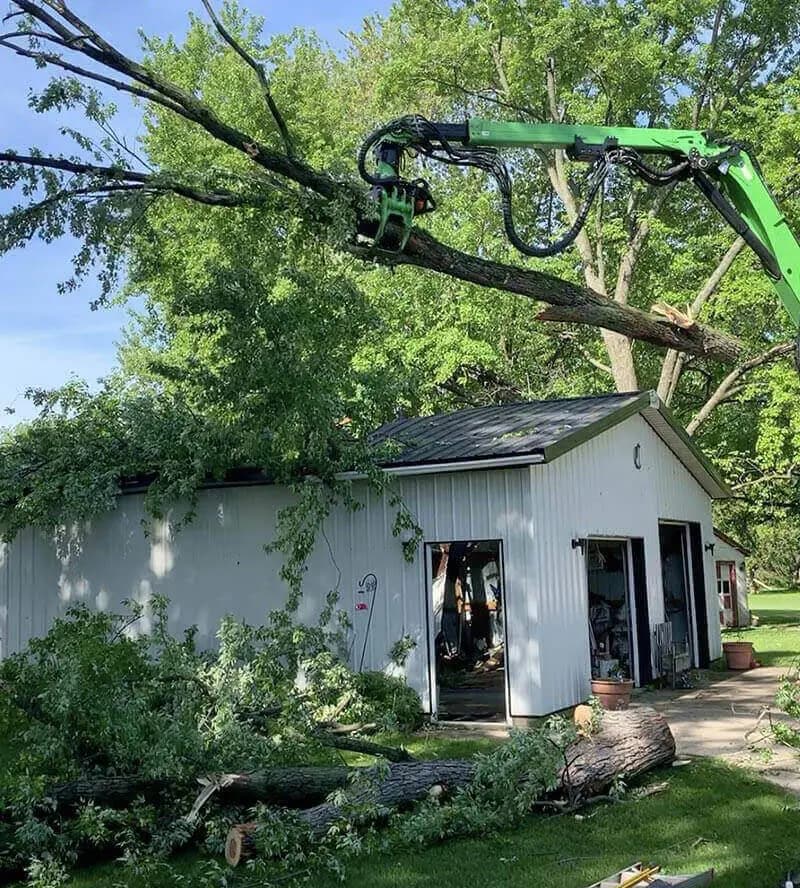
A storm-damaged tree in Cartersville becomes an emergency when it threatens people, structures, utilities, or essential access. Not every broken limb requires after-hours work, but a tree on a building, a blocked driveway, a live-line conflict, or visible root failure changes the priority. The first objective is safety; cosmetic cleanup comes later. After a tree falls, resist the urge to start cutting. Unstable trunks and limbs can shift, and electrical lines may still be energized. Keep the site clear, use 911 for urgent safety issues, and contact the utility if wires are involved. Safe photographs, an insurance notice, and a written emergency scope create a cleaner record before debris is moved.

How to frame tree trimming & pruning in Cartersville

For Cartersville homeowners, the quality of a pruning plan depends on why each cut is being made. Deadwood removal, clearance, structural correction, and crown reduction call for different selections. The American National Standards Institute A300 tree-care standard provides the professional framework. A proposal that simply promises to make a tree 'smaller' without describing technique deserves clarification. Do not use one pruning calendar for every tree. Many deciduous species respond well to late-dormant work, but oaks should generally avoid the February-to-June oak-wilt risk window, and flowering ornamentals such as dogwoods and redbuds are often pruned after bloom to preserve flowers. Dead or broken limbs that threaten people or property override seasonal preferences.

What emergency crews typically do

Key points for emergency tree service include the following practical considerations.

  • Immediate hazard mitigation: securing loose sections, tarping penetrations, cutting sections that block egress or roadways
  • Coordinated removal, often crane-assisted when a tree is on a structure
  • Debris removal or stacking, depending on scope agreed
  • Documentation to support the homeowner's insurance claim

Insurance dynamics

Damage to a covered structure from a fallen tree is generally reimbursable under standard Georgia homeowners policies, but removal of a fallen tree that did not damage a covered structure often is not — with limited exceptions such as blocking a driveway or accessibility ramp. Coverage varies significantly by policy; homeowners should read their declarations page and call their carrier. Documentation — photos, a provider's written estimate, an itemized invoice — strengthens any claim.

Pricing expectations

In metro Atlanta, emergency tree removal typically runs 20% to 50% above standard tree removal pricing. A tree that would cost around $1,200 to remove in a scheduled slot may cost $1,500 to $1,800 as an after-hours emergency job. Cranes, when required, add material cost. Homeowners should be cautious of "storm chasers" — out-of-area operators who arrive after major events, demand large cash deposits upfront, and are hard to hold accountable if work is incomplete or damaging. Preferring a local, insured provider with a physical address and verifiable insurance carrier is the best defense.

Storm & Weather Risk

Georgia is part of the southeastern severe-weather corridor sometimes called "Dixie Alley." The National Oceanic and Atmospheric Administration's Storm Events Database records 2,285 confirmed tornadoes in Georgia from 1950 through September 2025. April is Georgia's peak tornado month.

Two events in the recent record illustrate how quickly the region can generate simultaneous storm-related tree damage:

The Georgia Forestry Commission notes that even minor winds during ice-loading events can break or uproot trees, and wind is a major contributor to storm-related tree damage overall.

  • February 11–13, 2014 ice storm. According to the University of Georgia Cooperative Extension, more than 90 Georgia counties experienced winter precipitation, with ice accumulation ranging from a tenth of an inch to more than one inch from north metro Atlanta to Augusta and from Macon to Sylvania. Widespread tree damage occurred; power was disrupted to nearly one million customers. A state of emergency was declared and a federal emergency declaration followed.
  • September 2009 floods. According to the Georgia Emergency Management Agency, 500-year floods in northern Georgia damaged approximately 20,000 homes, businesses, and other buildings. Twenty-three counties received federal disaster declarations; at least ten deaths occurred and damage totaled roughly $500 million.

Georgia Statewide Legal Baseline (Private-Property Removal)

Georgia does not have a statewide tree removal permit requirement for private residential property. Local municipalities and counties may enact their own tree protection ordinances, and many metro Atlanta jurisdictions have done so. Trees near sidewalks, curbs, or within the public right-of-way may require city approval regardless of the property's private ownership.

Under Georgia common law, if a healthy tree falls on a neighbor's property in a storm, the affected property owner's own insurance typically handles their own damage. The originating owner is generally not liable unless they knew or should have known the tree was hazardous and failed to act — which is one reason documenting concerns about a visibly declining neighbor's tree in writing can matter later.

What helps a provider assess the service request

This page combines the service and location without pretending to know the property. Add real site details in the service request flow.

01

A tree or large limb has fallen on a structure or access route

02

A damaged tree is shifting or at risk of falling

03

Storm damage has left hanging or broken limbs

04

Tree damage is creating an immediate safety concern

Use the property—not generic local claims

CanopyFind does not publish an assumed provider price, availability window, or credential for Cartersville. Property-specific details should be confirmed for the actual job.

Read the complete emergency service guide

Before you compare options

  • Keep a safe distance from unstable trees and hanging limbs.
  • If a line may be energized, contact the utility or emergency services first.
  • Use photos only when they can be taken from a safe location.
worker cutting a storm-damaged tree near a home

Related CanopyFind guides

Use the parent location and service guides for broader context, compare a related service in this city, or compare the same service in another approved launch market.

Sources used on this page

Government, university, and public-agency references below support local rules, forestry guidance, storm history, and other factual context used on this page.

Emergency service questions

What counts as a tree emergency?

Any situation where a tree, limb, or unstable root plate creates continued risk to people, structures, vehicles, or utilities. Common triggers include a tree on a house or vehicle, a tree blocking a driveway or road, a large hanging limb after a storm, or a mature tree that has begun leaning after saturated soil.

What should I do first if a tree falls on my house?

Stay clear of the tree and any downed lines. Call 911 if there is injury, a gas leak, or a downed live line. Contact your utility for line involvement. Document with photos before anyone touches the tree. Contact your insurance carrier to open a claim. Then request a scoped emergency estimate from a qualified tree service.

Are downed power lines always dangerous?

Assume every downed line is energized. Do not touch or move any tree that is in contact with a line. Wait for the utility to secure the line before any tree work begins. Reputable tree services will not begin cutting on a line-adjacent tree until the utility has cleared it.

How much extra does emergency tree service cost compared to a scheduled removal?

Emergency tree service in metro Atlanta typically runs 20% to 50% above standard removal rates, reflecting after-hours labor, urgent dispatch, and increased safety risk.

Does Cartersville require a tree removal permit?

No. The City of Cartersville states that a permit is not required for tree removal or pruning. The one exception: trees removed that were included on a landscape plan, as part of approved development plans, must be replaced.

What is the exception to Cartersville's no-permit rule?

Trees included in an approved development plan's landscape plan must be replaced if removed. This applies most often in newer subdivisions and commercial properties where trees were counted toward landscape plan compliance at approval.

Is there a state forestry office in Cartersville?

Yes. The Georgia Forestry Commission's Mountain District Office is based in Cartersville at (770) 387-4900. It coordinates land-clearing burn permits and regional forestry response for Bartow, Catoosa, Chattooga, Cherokee, Cobb, and other North Georgia counties.

What hardiness zone is Cartersville in?

Under the U.S. Department of Agriculture's 2023 Plant Hardiness Zone Map update, Bartow County falls generally in Zone 8a.

Start your emergency tree service request in Cartersville

Tell CanopyFind what you need, where the property is, and when you need help.

Start a service request