CanopyFind

Stump Grinding in Cartersville, GA

For a stump grinding request in Cartersville, start with the local rule, the tree and site conditions, and the exact scope you want a provider to evaluate. The sections below combine Cartersville-specific context with practical stump grinding guidance.

Share the stump width and a photo with surrounding access visible.

Mention gates, slopes, hardscape, and known underground utilities.

tree-service worker operating a stump grinder in a residential yard

Start your stump grinding request

Choose the tree work that applies and tell us where the property is. You can add details in the next step.

Services Select all that apply

Submitting a service request does not book a job.

Stump Grinding in Cartersville: local factors first

Cartersville does not require a city permit for routine residential stump grinding. Larger properties can create multi-stump projects, while rural-fringe sites may also contain private well, septic, propane, irrigation, or other underground systems that are not necessarily covered by standard public utility marking and should be disclosed before grinding.
Local tree canopy character

Cartersville sits at the Piedmont-Ridge & Valley transition. Residential canopy is dominated by oaks (white, southern red, chestnut), loblolly and shortleaf pines, hickories, tulip poplar, sweetgum, and southern magnolia. The historic districts contain significant mature specimen trees. Bartow County has considerable rural and semi-rural residential settings compared with the denser Cobb suburbs, meaning older-growth trees and larger lot sizes are more common.

Local pest and disease pressure

Bartow County is under the Georgia Forestry Commission's statewide Emerald Ash Borer quarantine that has been in effect since December 2017. Southern Pine Beetle risk is present in pine-dominated stands. The proximity to state forests and mixed rural land introduces additional forest-pest exposure compared with dense urban settings.

Storm exposure

Cartersville shares the broader severe-weather pattern seen across northwest Georgia. The area is served from the Georgia Forestry Commission's Mountain District Office in Cartersville — (770) 387-4900 — which coordinates land-clearing burn permits and regional forestry response for a wide swath of North Georgia counties.

What to expect during the job

Key points for stump grinding include the following practical considerations.

  • Assessment. The provider verifies stump size and access; some walk-behind machines require a 36-inch gate clearance.
  • Utility marks. For stumps near property lines or in front yards, calling 811 for a utility locate before grinding is often prudent.
  • Debris protection. The provider places tarps or shields to catch flying chips.
  • Grinding. Most residential stumps take 30 minutes to 2 hours.
  • Chip pile. The homeowner chooses to keep the chips as mulch (free, useful in beds) or pay to have them removed and the hole filled with soil.
  • Site walk. The provider confirms depth and clears debris.

After grinding — replanting the same spot

Fresh stump-grinding chips are high in carbon and low in nitrogen; as they decompose, they will temporarily tie up soil nitrogen. If replanting a new tree in the same location, the standard practice is to remove the chips and backfill with quality topsoil rather than plant directly into the chip pile. Even then, replanting immediately in the exact same spot as the original tree is not ideal — moving 6 to 10 feet to fresh soil produces better establishment.

Climate & Growing Conditions

Northwest Georgia spans both the northwest side of metropolitan Atlanta and the Ridge and Valley region.

Under the U.S. Department of Agriculture's 2023 Plant Hardiness Zone Map update, Cobb, Cherokee, and Bartow counties fall in Zones 8a–8b, meaning the average annual extreme minimum temperature runs between 10°F and 20°F. This is a half-zone warmer than the 2012 map, which placed much of the area in Zone 7b–8a. Floyd County (Rome) sits at the transition between the Piedmont and the Ridge and Valley region, generally Zone 7b–8a.

The regional climate is humid subtropical: hot summers, mild winters, and precipitation distributed through the year.

Common Trees Found on Residential Properties

Native and naturalized species commonly found on residential lots across northwest Georgia, according to University of Georgia Cooperative Extension resources, include:

  • Oaks: white oak, southern red oak, willow oak, water oak, black oak, chestnut oak
  • Pines: loblolly pine, shortleaf pine, Virginia pine, eastern white pine (at higher elevations)
  • Hickories: mockernut, pignut, shagbark
  • Other hardwoods: tulip poplar (yellow poplar), sweetgum, red maple, silver maple, black gum, American beech, sycamore, river birch, black walnut, pecan
  • Understory and flowering: dogwood, redbud, American holly, sourwood, southern magnolia, bigleaf magnolia
  • Cedars and evergreens: eastern red cedar; Leyland cypress (planted, not native)

Georgia Statewide Legal Baseline (Private-Property Removal)

Georgia does not have a statewide tree removal permit requirement for private residential property. Local municipalities and counties may enact their own tree protection ordinances, and many metro Atlanta jurisdictions have done so. Trees near sidewalks, curbs, or within the public right-of-way may require city approval regardless of the property's private ownership.

Under Georgia common law, if a healthy tree falls on a neighbor's property in a storm, the affected property owner's own insurance typically handles their own damage. The originating owner is generally not liable unless they knew or should have known the tree was hazardous and failed to act — which is one reason documenting concerns about a visibly declining neighbor's tree in writing can matter later.

Depth and access change the scope of stump work

A stump-grinding quote should identify more than the visible stump diameter. Standard work generally grinds the stump and nearby roots below the surface, while deeper grinding for replanting and extended surface-root grinding can add labor. Access also matters: a backyard behind a narrow gate may require a smaller walk-behind grinder rather than larger equipment. Before work begins, homeowners should identify irrigation, private utility lines, septic components, propane lines, or other site features that may not be represented by a standard public utility locate. Clarifying those conditions in advance makes the written scope easier to compare and reduces uncertainty around the work area.

What helps a provider assess the service request

This page combines the service and location without pretending to know the property. Add real site details in the service request flow.

01

A stump is blocking mowing, planting, or a planned project

02

Surface roots or the stump create a trip concern

03

A recent removal left a stump to address separately

04

The area needs a cleaner, more usable finish

Use the property—not generic local claims

CanopyFind does not publish an assumed provider price, availability window, or credential for Cartersville. Property-specific details should be confirmed for the actual job.

Read the complete stump grinding guide

Before you compare options

  • Share the stump width and a photo with surrounding access visible.
  • Mention gates, slopes, hardscape, and known underground utilities.
  • Ask how grindings, backfill, and surface cleanup will be handled.
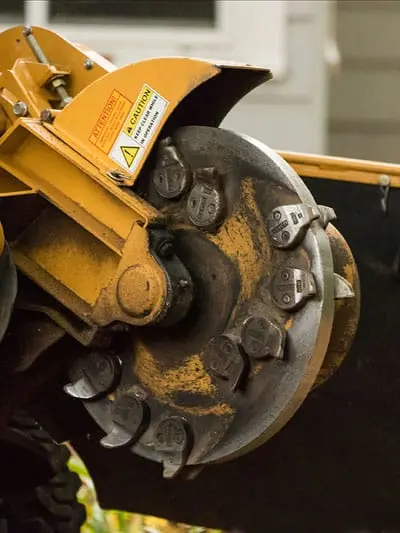
close-up of a stump grinder cutting wheel and teeth

Related CanopyFind guides

Use the parent location and service guides for broader context, compare a related service in this city, or compare the same service in another approved launch market.

Sources used on this page

Government, university, and public-agency references below support local rules, forestry guidance, storm history, and other factual context used on this page.

Stump grinding questions

How much does stump grinding cost in metro Atlanta?

The market convention is $2 to $5 per inch of stump diameter, with a $100 to $150 minimum service fee that covers travel and setup. Typical residential jobs run $100 to $400 per stump. In the metro Atlanta market specifically, per-stump pricing typically falls between $120 and $210.

What is the difference between stump grinding and stump removal?

Stump grinding chips the stump down below the surrounding soil surface (typically 4 to 12 inches deep), leaving a chip pile and the root system in place. Stump removal excavates the stump and the root ball entirely, and is more expensive and disruptive. Stump grinding is the standard residential approach.

How deep is a stump ground?

Standard grinding depth is 4 to 12 inches below the surrounding soil surface. Deeper grinds are available at higher cost and are typically requested when the homeowner intends to replant a new tree in the same location.

Can I plant a new tree in the exact spot the stump was ground?

It's not ideal. Fresh grinding chips are high in carbon and low in nitrogen and will temporarily tie up soil nitrogen as they decompose. If replanting is planned, the standard practice is to remove chips and backfill with quality topsoil. Even then, moving the new tree 6 to 10 feet away from the original stump gives it fresh soil and better establishment.

Does Cartersville require a tree removal permit?

No. The City of Cartersville states that a permit is not required for tree removal or pruning. The one exception: trees removed that were included on a landscape plan, as part of approved development plans, must be replaced.

What is the exception to Cartersville's no-permit rule?

Trees included in an approved development plan's landscape plan must be replaced if removed. This applies most often in newer subdivisions and commercial properties where trees were counted toward landscape plan compliance at approval.

Is there a state forestry office in Cartersville?

Yes. The Georgia Forestry Commission's Mountain District Office is based in Cartersville at (770) 387-4900. It coordinates land-clearing burn permits and regional forestry response for Bartow, Catoosa, Chattooga, Cherokee, Cobb, and other North Georgia counties.

What hardiness zone is Cartersville in?

Under the U.S. Department of Agriculture's 2023 Plant Hardiness Zone Map update, Bartow County falls generally in Zone 8a.

Start your stump grinding request in Cartersville

Tell CanopyFind what you need, where the property is, and when you need help.

Start a service request