CanopyFind

Tree Removal in Rome, GA

For a tree removal request in Rome, start with the local rule, the tree and site conditions, and the exact scope you want a provider to evaluate. The sections below combine Rome-specific context with practical tree removal guidance.

Describe nearby homes, fences, utilities, and access points.

Ask what removal, hauling, and site cleanup are included.

arborist climbing a mature tree with ropes and safety gear

Start your tree removal request

Choose the tree work that applies and tell us where the property is. You can add details in the next step.

Services Select all that apply

Submitting a service request does not book a job.

Tree Removal in Rome: local factors first

Rome and Floyd County use a joint Unified Land Development Code; routine single-family residential removal not tied to development is generally outside the code's development-oriented tree provisions, while historic districts, protected zones, public rights-of-way, and land-disturbance work can require coordination. Rome's river corridors and seven-hill terrain create a mix of riparian and upland tree conditions.
How to frame emergency tree service in Rome

For Rome homeowners, an emergency tree call should describe what changed suddenly and what remains unsafe. A downed tree, suspended limb, new lean, uplifted roots, or blocked egress can all warrant urgent evaluation. The work is often more complex than a scheduled removal because the tree may already be resting on a structure or entangled with utilities. Immediate response should follow a simple order: people first, utilities second, documentation third, tree work after the site is safe. Keep away from downed lines; involve 911 for injury, gas, collapse, or live electrical danger; and call the utility for line conflicts. Then photograph conditions from a safe position and preserve written estimates for any insurance claim.

How to frame tree trimming & pruning in Rome

Pruning on a Rome lot should solve a specific tree or clearance problem while keeping as much healthy canopy as practical. Common objectives include removing broken limbs, improving branch structure, opening clearance, thinning selected density, or reducing spread with lateral cuts. Topping is not a shortcut to those outcomes; it can create decay and poorly attached replacement shoots. Georgia's climate allows pruning in several seasons, but late dormancy is generally preferred for major structural work on most deciduous trees. Planned oak pruning should avoid the period from about February through June because of oak-wilt concerns. Light summer work can be appropriate, spring-flowering trees are commonly pruned after bloom, and hazard removal is performed when the hazard exists.

How to frame stump grinding in Rome

A Rome stump request should state the desired finished condition. Grinding normally chips the stump below grade while leaving most roots in the soil; complete removal excavates the stump and root ball. Because grinding is quicker and less disruptive, it is commonly selected for residential lawns and beds unless construction or replanting requires more extensive excavation. Cost depends on how much material must be ground and how difficult it is to reach. Stump diameter is the primary pricing variable, with hardwood density, surface roots, deeper grinding, narrow access, structures, irrigation, and utilities adding complexity. Many residential jobs fall between about $100 and $400, but the provider's written scope should control the comparison.

When removal is not the answer

Trees that are structurally sound but oversized for their setting can often be corrected with structural pruning, crown reduction, or cabling by a qualified arborist. Trees with limited crown dieback — under about 20% for hardwoods — or minor deadwood are usually candidates for pruning rather than removal. Storm damage that has broken a few limbs but left the main trunk and root system intact often qualifies for repair, especially on large mature specimens whose replacement value is significant.

What drives the cost of tree removal in metro Atlanta

  • Height and trunk diameter. The primary cost driver. Tall trees require more climbing time, more rigging, and often crane time. Small trees under 30 feet can start around $150 to $500. Very large hardwoods over 90 feet can exceed $4,500, and complex jobs can reach $10,000 or more.
  • Proximity to structures. A tree free-falling into an open yard is significantly less expensive than the same tree overhanging a roof, pool, fence, driveway, or power line.
  • Species and wood density. Hardwoods like oak and hickory are denser and slower to cut than softer species like pine, sweetgum, and tulip poplar.
  • Access. Backyard trees that require hand-carrying debris through gates cost more than trees a truck can pull up to.
  • Disposal. Chipping and hauling brush and trunk sections is usually included; some providers offer to leave firewood-length logs at a reduced cost.
  • Permits and replacement fees. In cities that require tree removal permits or replacement fees for protected trees, those charges are separate from the removal quote.
  • Storm and emergency premium. Emergency tree removal typically runs 20% to 50% above standard prices because of urgency, added safety measures, and after-hours labor.

What to expect during the job

  • Most reputable companies provide free estimates that specify the tree to be removed, method (climb vs. crane), whether the stump is included, and cleanup scope.
  • The Georgia Forestry Commission and the Atlanta Tree Conservation Commission both recommend homeowners request a written proposal that names the American National Standards Institute A300 tree care standard and lists insurance information.
  • The homeowner (or the contractor on their behalf) is responsible for any city permits before work begins.
  • For trees near power lines, the provider coordinates with the utility, or the homeowner may need to schedule a temporary line drop.
  • Protection of hardscapes, plantings, and structures.
  • Top-down dismantling by a climber or bucket, or crane-assisted lifting.
  • Brush chipped, trunk sections hauled or stacked per agreement.
  • Usually quoted separately by inch of stump diameter.

Verifying a provider before hiring

The Georgia Forestry Commission recommends verifying proof of general liability insurance and workers' compensation coverage by calling the insurance carrier directly, requesting references and, when possible, visiting finished work, and getting written estimates that include credentials, scope, and all costs. Because Georgia does not license arborists at the state level, International Society of Arboriculture certification is the primary industry credential a homeowner can look for. The Atlanta Tree Conservation Commission adds a specific recommendation to request American National Standards Institute A300 compliance and involvement by a certified arborist.

Insurance and liability basics for Georgia homeowners

Standard homeowners insurance generally covers damage from a fallen tree to a covered structure such as a house, garage, or fence. Many policies do not cover the cost of removing a fallen tree that did not damage a structure, though limited exceptions exist for situations like a tree blocking a driveway or an accessibility ramp. If a neighbor's tree falls onto your property, your own insurance usually handles your own damage under Georgia's typical common-law approach — unless the neighbor knew or should have known the tree was hazardous and failed to act. Homeowners should always confirm coverage specifics with their own carrier.

What helps a provider assess the service request

This page combines the service and location without pretending to know the property. Add real site details in the service request flow.

01

A tree is dead, severely damaged, or declining

02

The trunk or major limbs are leaning toward a structure

03

Roots or growth conflict with a planned project

04

A fallen tree or major limb needs to be cleared

Use the property—not generic local claims

CanopyFind does not publish an assumed provider price, availability window, or credential for Rome. Property-specific details should be confirmed for the actual job.

Read the complete removal guide

Before you compare options

  • Describe nearby homes, fences, utilities, and access points.
  • Ask what removal, hauling, and site cleanup are included.
  • Discuss stump plans separately so expectations are clear.
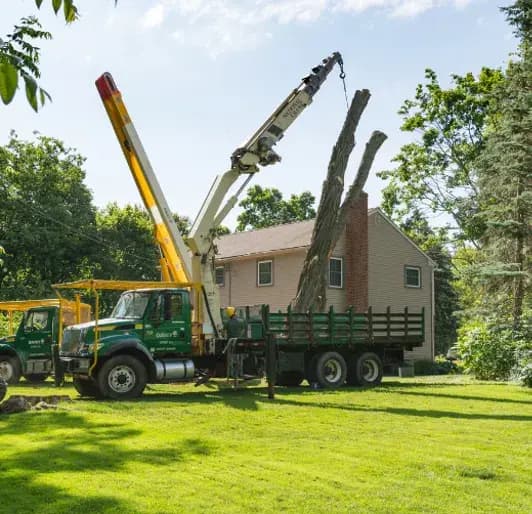
tree removal crew using a crane to lift cut tree sections near a home

Related CanopyFind guides

Use the parent location and service guides for broader context, compare a related service in this city, or compare the same service in another approved launch market.

Sources used on this page

Government, university, and public-agency references below support local rules, forestry guidance, storm history, and other factual context used on this page.

Removal questions

Do I need a permit to remove a tree in Georgia?

Georgia does not have a statewide tree removal permit requirement for private residential property. Local municipalities and counties may enact their own tree protection ordinances, and many metro Atlanta jurisdictions have done so. Requirements vary meaningfully between cities — for example, Woodstock requires a free permit for any tree three inches diameter at breast height or greater, Kennesaw requires a $25 permit, and Marietta requires no permit for single-family residential lots. Confirm with your local city or county before removing a tree.

How much does tree removal cost in metro Atlanta?

Metro Atlanta market ranges run from about $200 for small, straightforward jobs to $2,000 or more for large hardwoods in complex settings. Typical residential jobs average roughly $750 to $880. Very large removals — trees 90 feet tall or with trunks more than 36 inches across — can exceed $4,500. Actual pricing depends on tree size, species, access, proximity to structures, and any permit or replacement fees.

What factors change the price of a tree removal quote?

The main drivers are tree height and trunk diameter, proximity to structures and power lines, species and wood density, access (backyards versus open front yards), disposal choices, and any permit or replacement fees required by the city. Emergency and after-hours work typically costs 20% to 50% more than a scheduled removal.

What insurance should a tree removal company carry?

The Georgia Forestry Commission recommends verifying that any provider carries current general liability insurance and workers' compensation coverage, and calling the insurance carrier directly to confirm the policy is active. Because Georgia does not license arborists at the state level, insurance verification and International Society of Arboriculture certification are the primary quality signals to look for.

Do I need a permit to remove a tree on private property in Rome?

Rome and Floyd County operate under a joint Unified Land Development Code adopted in 2001. Routine residential tree removal on established single-family lots not tied to a building permit or land disturbance action is not generally regulated by the code's tree provisions. Removals in a Historic District, in a protected zone, on trees in the public right-of-way, or in connection with a development project require coordination with the Rome-Floyd County Planning & Zoning Department at (706) 236-5025.

Who manages the trees in Rome parks and along city streets?

The City of Rome's Urban Forestry division. The City of Rome Tree Board — a citizen-volunteer body that includes garden club members, the Floyd County Extension Agent, Keep Rome-Floyd Beautiful, the Georgia Forestry Commission, and Floyd County Public Works — advises staff on public-tree matters.

What hardiness zone is Rome in?

Under the U.S. Department of Agriculture's 2023 Plant Hardiness Zone Map update, Floyd County generally falls in Zone 7b to 8a — slightly cooler than the metro Atlanta cities to the southeast.

Does Rome have historic flood risk that affects trees?

Yes. Rome sits at the confluence of the Etowah and Oostanaula rivers, which form the Coosa. Historic floods have been significant — in 1886 a flood was reported deep enough to allow a steamboat down Broad Street — and levees plus the raising of Broad Street in the late 1890s were long-standing responses. Riparian trees along the rivers experience flood-related root stress that affects both stability and pruning decisions.

Start your tree removal request in Rome

Tell CanopyFind what you need, where the property is, and when you need help.

Start a service request