CanopyFind

Stump Grinding in Rome, GA

For a stump grinding request in Rome, start with the local rule, the tree and site conditions, and the exact scope you want a provider to evaluate. The sections below combine Rome-specific context with practical stump grinding guidance.

Share the stump width and a photo with surrounding access visible.

Mention gates, slopes, hardscape, and known underground utilities.

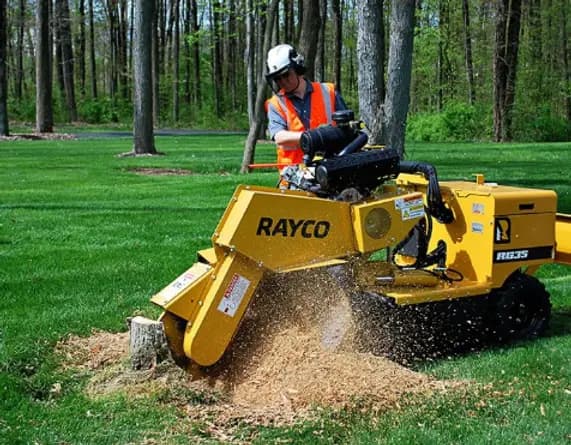
tree-service worker operating a stump grinder in a residential yard

Start your stump grinding request

Choose the tree work that applies and tell us where the property is. You can add details in the next step.

Services Select all that apply

Submitting a service request does not book a job.

Stump Grinding in Rome: local factors first

Routine stump grinding on private residential property in Rome does not generally require a tree permit, while historic districts, protected zones, or development work can require additional review. Upland hardwood stumps and lower-elevation riparian species differ in density, and bank-adjacent grinding should avoid unnecessary root loss that contributes to soil stability.
Local tree canopy character

Rome sits at the transition between the Piedmont and the Ridge and Valley province. Residential canopy is diverse: oak-hickory (white oak, southern red oak, chestnut oak, mockernut and shagbark hickory), pine (loblolly, shortleaf, Virginia pine), tulip poplar, sweetgum, sycamore (common along the rivers), river birch, red maple, black walnut, and native flowering understory (dogwood, redbud, sourwood, American holly). Rome's seven hills — several of which have parks or cemeteries — support significant mature specimen trees, and the riverine corridors along the Etowah, Oostanaula, and Coosa carry cypress, sycamore, and river birch.

Regional forestry note

Rome is the largest city in Northwest Georgia and the transition point between the metropolitan Atlanta forestry culture and the more rural, timber-oriented culture of the Northwest Georgia mountains. Berry College — immediately outside the city limits — contains one of the largest contiguous campus forests in the United States and shapes local awareness of forest management.

Local pest and disease pressure

The Georgia Forestry Commission's statewide Emerald Ash Borer quarantine (effective December 2017) applies. Floyd County is in the Ridge and Valley region, where Southern Pine Beetle historic outbreak intervals — reported by the Georgia Forestry Commission as six to ten years in the Piedmont — transition to approximately twelve years in mountain regions. Riparian species along Rome's rivers face flood-related root stress in high-water events.

Cost drivers in metro Atlanta

Key points for stump grinding include the following practical considerations.

  • Stump diameter measured at the widest point at ground level is the primary cost driver. The market convention across metro Atlanta and much of the country is $2 to $5 per inch of stump diameter.
  • Minimum service fee. Most providers have a minimum of $100 to $150 to cover travel and setup, meaning small stumps that would price under the minimum on a per-inch basis still charge the minimum.
  • Wood hardness. Hardwoods (oak, hickory, maple) are denser than softwoods (pine, sweetgum, tulip poplar) and wear grinder teeth faster.
  • Root system extent. Standard pricing typically covers the stump plus roots to 6 to 12 inches below the surface. Grinding surface roots that extend several feet from the stump costs extra.
  • Grinding depth. Deeper grinds, often needed for replanting a new tree in the same location, cost more.
  • Access. Backyards behind narrow gates may require a walk-behind grinder, which is slower than a truck-mounted unit.
  • Proximity to structures and utilities. Grinding near foundations, retaining walls, sprinkler systems, or underground utilities slows the work.

Typical metro Atlanta pricing

Most residential jobs run $100 to $400 per stump. A single average 12 to 18 inch stump typically runs $150 to $250. In the metro Atlanta market specifically, per-stump pricing typically falls between $120 and $210. Multiple-stump discounts are common when jobs are bundled.

What to expect during the job

Key points for stump grinding include the following practical considerations.

  • Assessment. The provider verifies stump size and access; some walk-behind machines require a 36-inch gate clearance.
  • Utility marks. For stumps near property lines or in front yards, calling 811 for a utility locate before grinding is often prudent.
  • Debris protection. The provider places tarps or shields to catch flying chips.
  • Grinding. Most residential stumps take 30 minutes to 2 hours.
  • Chip pile. The homeowner chooses to keep the chips as mulch (free, useful in beds) or pay to have them removed and the hole filled with soil.
  • Site walk. The provider confirms depth and clears debris.

After grinding — replanting the same spot

Fresh stump-grinding chips are high in carbon and low in nitrogen; as they decompose, they will temporarily tie up soil nitrogen. If replanting a new tree in the same location, the standard practice is to remove the chips and backfill with quality topsoil rather than plant directly into the chip pile. Even then, replanting immediately in the exact same spot as the original tree is not ideal — moving 6 to 10 feet to fresh soil produces better establishment.

Climate & Growing Conditions

Northwest Georgia spans both the northwest side of metropolitan Atlanta and the Ridge and Valley region.

Under the U.S. Department of Agriculture's 2023 Plant Hardiness Zone Map update, Cobb, Cherokee, and Bartow counties fall in Zones 8a–8b, meaning the average annual extreme minimum temperature runs between 10°F and 20°F. This is a half-zone warmer than the 2012 map, which placed much of the area in Zone 7b–8a. Floyd County (Rome) sits at the transition between the Piedmont and the Ridge and Valley region, generally Zone 7b–8a.

The regional climate is humid subtropical: hot summers, mild winters, and precipitation distributed through the year.

What helps a provider assess the service request

This page combines the service and location without pretending to know the property. Add real site details in the service request flow.

01

A stump is blocking mowing, planting, or a planned project

02

Surface roots or the stump create a trip concern

03

A recent removal left a stump to address separately

04

The area needs a cleaner, more usable finish

Use the property—not generic local claims

CanopyFind does not publish an assumed provider price, availability window, or credential for Rome. Property-specific details should be confirmed for the actual job.

Read the complete stump grinding guide

Before you compare options

  • Share the stump width and a photo with surrounding access visible.
  • Mention gates, slopes, hardscape, and known underground utilities.
  • Ask how grindings, backfill, and surface cleanup will be handled.
tree-service worker operating a stump grinder on a lawn

Related CanopyFind guides

Use the parent location and service guides for broader context, compare a related service in this city, or compare the same service in another approved launch market.

Sources used on this page

Government, university, and public-agency references below support local rules, forestry guidance, storm history, and other factual context used on this page.

Stump grinding questions

How much does stump grinding cost in metro Atlanta?

The market convention is $2 to $5 per inch of stump diameter, with a $100 to $150 minimum service fee that covers travel and setup. Typical residential jobs run $100 to $400 per stump. In the metro Atlanta market specifically, per-stump pricing typically falls between $120 and $210.

What is the difference between stump grinding and stump removal?

Stump grinding chips the stump down below the surrounding soil surface (typically 4 to 12 inches deep), leaving a chip pile and the root system in place. Stump removal excavates the stump and the root ball entirely, and is more expensive and disruptive. Stump grinding is the standard residential approach.

How deep is a stump ground?

Standard grinding depth is 4 to 12 inches below the surrounding soil surface. Deeper grinds are available at higher cost and are typically requested when the homeowner intends to replant a new tree in the same location.

Can I plant a new tree in the exact spot the stump was ground?

It's not ideal. Fresh grinding chips are high in carbon and low in nitrogen and will temporarily tie up soil nitrogen as they decompose. If replanting is planned, the standard practice is to remove chips and backfill with quality topsoil. Even then, moving the new tree 6 to 10 feet away from the original stump gives it fresh soil and better establishment.

Do I need a permit to remove a tree on private property in Rome?

Rome and Floyd County operate under a joint Unified Land Development Code adopted in 2001. Routine residential tree removal on established single-family lots not tied to a building permit or land disturbance action is not generally regulated by the code's tree provisions. Removals in a Historic District, in a protected zone, on trees in the public right-of-way, or in connection with a development project require coordination with the Rome-Floyd County Planning & Zoning Department at (706) 236-5025.

Who manages the trees in Rome parks and along city streets?

The City of Rome's Urban Forestry division. The City of Rome Tree Board — a citizen-volunteer body that includes garden club members, the Floyd County Extension Agent, Keep Rome-Floyd Beautiful, the Georgia Forestry Commission, and Floyd County Public Works — advises staff on public-tree matters.

What hardiness zone is Rome in?

Under the U.S. Department of Agriculture's 2023 Plant Hardiness Zone Map update, Floyd County generally falls in Zone 7b to 8a — slightly cooler than the metro Atlanta cities to the southeast.

Does Rome have historic flood risk that affects trees?

Yes. Rome sits at the confluence of the Etowah and Oostanaula rivers, which form the Coosa. Historic floods have been significant — in 1886 a flood was reported deep enough to allow a steamboat down Broad Street — and levees plus the raising of Broad Street in the late 1890s were long-standing responses. Riparian trees along the rivers experience flood-related root stress that affects both stability and pruning decisions.

Start your stump grinding request in Rome

Tell CanopyFind what you need, where the property is, and when you need help.

Start a service request