CanopyFind

Emergency Tree Service in Woodstock, GA

For an emergency tree service request in Woodstock, start with the local rule, the tree and site conditions, and the exact scope you want a provider to evaluate. The sections below combine Woodstock-specific context with practical emergency tree service guidance.

Keep a safe distance from unstable trees and hanging limbs.

If a line may be energized, contact the utility or emergency services first.

worker clearing heavy fallen tree branches after storm damage

Start your emergency tree service request

Choose the tree work that applies and tell us where the property is. You can add details in the next step.

Services Select all that apply

Submitting a service request does not book a job.

Emergency Tree Service in Woodstock: local factors first

Emergency hazards in Woodstock can require immediate action, but the city's broad permit framework still matters for post-storm removal and specimen-tree review. The Little River watershed can contribute to saturated soils and uprooting, while the regional tornado and severe-weather profile adds another source of sudden tree failure.

University of Georgia Cooperative Extension resource

Cherokee County Extension Office serves Woodstock.

How to frame tree removal in Woodstock

Tree removal on a Woodstock residential lot typically involves the entire above-ground tree, followed by agreed cleanup and wood handling. The stump may remain unless grinding or excavation is added. Access, tree size, and nearby targets determine whether the crew can fell the tree directly or needs climbing, rigging, bucket equipment, or a crane. A removal decision should be tied to observable condition and site risk. Major trunk decay, a compromised root plate, severe lean, widespread crown failure, or a dead tree present a different problem from a healthy tree that has grown too large for its setting. Where structure remains sound, crown reduction or structural pruning may preserve the tree and avoid an unnecessary removal.

How to frame emergency tree service in Woodstock

Emergency service is for conditions where delay leaves an active risk. On a Woodstock property that can mean a tree on a roof or car, a limb suspended above a driveway, or a leaning tree whose soil and roots have shifted. The scope may include immediate stabilization, controlled cutting, crane work, debris handling, and documentation for the homeowner's insurer. A homeowner should not try to free a tree from a power line or unstable structure. Move away from the area, call emergency services when there is an immediate life or building hazard, and let the utility de-energize involved lines. Once safe, document the damage and contact the insurance carrier.

Definition and scope

Emergency tree service covers unplanned tree work triggered by a sudden hazard: a tree on a house or vehicle, a tree blocking a driveway or road, a large limb hung up in the canopy after a storm, a leaning tree with lifted roots after saturated soil, or any situation where waiting for a normal appointment leaves people or property at continued risk. Most metro Atlanta providers price emergency work at a 20% to 50% premium over standard removal because of after-hours labor, urgent dispatch, and increased safety risk.

Why emergency tree work exists as a category in this region

Metro Atlanta and northwest Georgia sit inside the southeastern severe-weather corridor sometimes called "Dixie Alley." The National Oceanic and Atmospheric Administration's Storm Events Database records 2,285 confirmed tornadoes in Georgia from 1950 through September 2025, with April as the peak month. Beyond tornadoes, straight-line thunderstorm winds, ice loading, saturated-soil uprooting, and lightning strikes all produce sudden tree failures.

The February 11–13, 2014 ice storm illustrates how a single event can generate simultaneous demand across the entire region. According to the University of Georgia Cooperative Extension, that storm damaged trees in more than 90 Georgia counties and left nearly one million utility customers without power. In September 2009, according to the Georgia Emergency Management Agency, 500-year floods produced widespread tree damage across metro Atlanta and prompted 23 federal disaster declarations.

Pricing expectations

In metro Atlanta, emergency tree removal typically runs 20% to 50% above standard tree removal pricing. A tree that would cost around $1,200 to remove in a scheduled slot may cost $1,500 to $1,800 as an after-hours emergency job. Cranes, when required, add material cost. Homeowners should be cautious of "storm chasers" — out-of-area operators who arrive after major events, demand large cash deposits upfront, and are hard to hold accountable if work is incomplete or damaging. Preferring a local, insured provider with a physical address and verifiable insurance carrier is the best defense.

Storm & Weather Risk

Georgia is part of the southeastern severe-weather corridor sometimes called "Dixie Alley." The National Oceanic and Atmospheric Administration's Storm Events Database records 2,285 confirmed tornadoes in Georgia from 1950 through September 2025. April is Georgia's peak tornado month.

Two events in the recent record illustrate how quickly the region can generate simultaneous storm-related tree damage:

The Georgia Forestry Commission notes that even minor winds during ice-loading events can break or uproot trees, and wind is a major contributor to storm-related tree damage overall.

  • February 11–13, 2014 ice storm. According to the University of Georgia Cooperative Extension, more than 90 Georgia counties experienced winter precipitation, with ice accumulation ranging from a tenth of an inch to more than one inch from north metro Atlanta to Augusta and from Macon to Sylvania. Widespread tree damage occurred; power was disrupted to nearly one million customers. A state of emergency was declared and a federal emergency declaration followed.
  • September 2009 floods. According to the Georgia Emergency Management Agency, 500-year floods in northern Georgia damaged approximately 20,000 homes, businesses, and other buildings. Twenty-three counties received federal disaster declarations; at least ten deaths occurred and damage totaled roughly $500 million.

Georgia Statewide Legal Baseline (Private-Property Removal)

Georgia does not have a statewide tree removal permit requirement for private residential property. Local municipalities and counties may enact their own tree protection ordinances, and many metro Atlanta jurisdictions have done so. Trees near sidewalks, curbs, or within the public right-of-way may require city approval regardless of the property's private ownership.

Under Georgia common law, if a healthy tree falls on a neighbor's property in a storm, the affected property owner's own insurance typically handles their own damage. The originating owner is generally not liable unless they knew or should have known the tree was hazardous and failed to act — which is one reason documenting concerns about a visibly declining neighbor's tree in writing can matter later.

What helps a provider assess the service request

This page combines the service and location without pretending to know the property. Add real site details in the service request flow.

01

A tree or large limb has fallen on a structure or access route

02

A damaged tree is shifting or at risk of falling

03

Storm damage has left hanging or broken limbs

04

Tree damage is creating an immediate safety concern

Use the property—not generic local claims

CanopyFind does not publish an assumed provider price, availability window, or credential for Woodstock. Property-specific details should be confirmed for the actual job.

Read the complete emergency service guide

Before you compare options

  • Keep a safe distance from unstable trees and hanging limbs.
  • If a line may be energized, contact the utility or emergency services first.
  • Use photos only when they can be taken from a safe location.
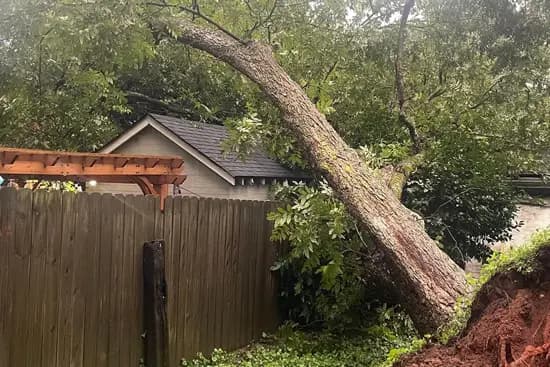
storm-damaged tree leaning across a residential fence

Related CanopyFind guides

Use the parent location and service guides for broader context, compare a related service in this city, or compare the same service in another approved launch market.

Sources used on this page

Government, university, and public-agency references below support local rules, forestry guidance, storm history, and other factual context used on this page.

Emergency service questions

What counts as a tree emergency?

Any situation where a tree, limb, or unstable root plate creates continued risk to people, structures, vehicles, or utilities. Common triggers include a tree on a house or vehicle, a tree blocking a driveway or road, a large hanging limb after a storm, or a mature tree that has begun leaning after saturated soil.

What should I do first if a tree falls on my house?

Stay clear of the tree and any downed lines. Call 911 if there is injury, a gas leak, or a downed live line. Contact your utility for line involvement. Document with photos before anyone touches the tree. Contact your insurance carrier to open a claim. Then request a scoped emergency estimate from a qualified tree service.

Are downed power lines always dangerous?

Assume every downed line is energized. Do not touch or move any tree that is in contact with a line. Wait for the utility to secure the line before any tree work begins. Reputable tree services will not begin cutting on a line-adjacent tree until the utility has cleared it.

How much extra does emergency tree service cost compared to a scheduled removal?

Emergency tree service in metro Atlanta typically runs 20% to 50% above standard removal rates, reflecting after-hours labor, urgent dispatch, and increased safety risk.

Does Woodstock require a permit to remove a tree?

Yes, for any tree three inches diameter at breast height or greater within the City of Woodstock. Diameter at breast height is measured 4.5 feet above the ground. The permit is free, but it is capped at five non-specimen trees per residential lot per calendar year. Even dead or dying trees require an approved permit.

What are the penalties for removing a tree in Woodstock without a permit?

Fines are paid to the Tree Preservation Fund based on the Land Development Code fee schedule. Violations are misdemeanors, and convictions may carry fines up to $1,000 per offense or up to six months imprisonment. Each day of continued violation may be considered a separate offense.

What qualifies as a specimen tree in Woodstock?

Specimen tree criteria depend on species. Tulip poplar, sweet gum, river birch, silver maple, or pine at 30 inches diameter at breast height or greater; ash, beech, blackgum, cedar, cypress, hickory, magnolia (excluding bigleaf), maple (excluding silver), pecan, persimmon, redwood, sourwood, sycamore, or walnut at 24 inches diameter at breast height or greater; American holly, dogwood, redbud, or bigleaf magnolia at criteria determined by the city arborist.

Is there a Woodstock urban tree canopy plan?

Yes. The Georgia Forestry Commission published an Urban Tree Canopy Assessment for the City of Woodstock in March 2024, identifying strategies for tree preservation, code audits, staff training, "Right Tree, Right Place" public education, and formalizing the city's tree board.

Start your emergency tree service request in Woodstock

Tell CanopyFind what you need, where the property is, and when you need help.

Start a service request