CanopyFind

Tree Removal in Woodstock, GA

For a tree removal request in Woodstock, start with the local rule, the tree and site conditions, and the exact scope you want a provider to evaluate. The sections below combine Woodstock-specific context with practical tree removal guidance.

Describe nearby homes, fences, utilities, and access points.

Ask what removal, hauling, and site cleanup are included.

arborist climbing a mature tree with ropes and safety gear

Start your tree removal request

Choose the tree work that applies and tell us where the property is. You can add details in the next step.

Services Select all that apply

Submitting a service request does not book a job.

Tree Removal in Woodstock: local factors first

Woodstock requires a permit for removing trees three inches diameter at breast height or greater; the permit is free, with limits and additional rules for specimen trees. Many residential lots retain mature hardwoods that predate subdivision development, and the city's 2024 Urban Tree Canopy Assessment underscores an active municipal focus on canopy preservation.

How to frame emergency tree service in Woodstock

Emergency service is for conditions where delay leaves an active risk. On a Woodstock property that can mean a tree on a roof or car, a limb suspended above a driveway, or a leaning tree whose soil and roots have shifted. The scope may include immediate stabilization, controlled cutting, crane work, debris handling, and documentation for the homeowner's insurer. A homeowner should not try to free a tree from a power line or unstable structure. Move away from the area, call emergency services when there is an immediate life or building hazard, and let the utility de-energize involved lines. Once safe, document the damage and contact the insurance carrier.

How to frame tree trimming & pruning in Woodstock

Tree trimming and tree pruning are used interchangeably in ordinary conversation, but a Woodstock scope should still identify the objective. Structural pruning, crown cleaning, crown raising, thinning, and crown reduction are different operations. Proper cuts are targeted; topping relies on indiscriminate heading cuts and produces weak regrowth that can make the tree harder to manage later. Timing is part of the prescription. For many Georgia deciduous trees, late November through February is a practical dormant-season window. Oaks are more restrictive because fresh wounds during roughly February to June can increase oak-wilt transmission risk; November through January is the safer planned period. Spring-flowering ornamentals are usually pruned after bloom, while safety hazards are addressed whenever they appear.

How to frame stump grinding in Woodstock

Grinding and full stump removal solve the same visible problem in different ways. On a Woodstock residential lot, grinding usually takes the stump down roughly 4 to 12 inches and leaves the deeper root system to decay naturally. Excavation removes the root ball but creates a larger hole and more disturbance. The intended use of the site should determine which scope is appropriate. Grinding prices are tied to machine time and access. Diameter at the widest point near grade is the usual starting measure, followed by wood density, root spread, depth, and obstacles. Walk-behind equipment may be necessary when gates are narrow, which can slow the work.

Definition and scope

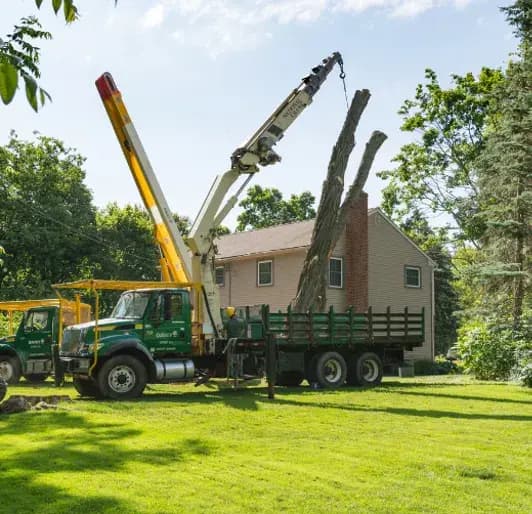
Tree removal is the complete felling of a standing tree — trunk and branches — followed by stump grinding or stump removal (billed separately) and site cleanup. In residential settings the work typically requires a climbing crew or a bucket truck, rigging to lower cut sections in confined yards, chipping of brush, and hauling of the trunk. In tighter urban lots or where the tree overhangs structures, cranes are sometimes used to lift sections clear of the drop zone.

Tree work is inherently dangerous. The Georgia Forestry Commission recommends choosing a company that carries current general liability insurance and workers' compensation coverage and, ideally, includes at least one arborist certified through the International Society of Arboriculture on the crew or on staff.

When removal is the right decision

Removal is generally appropriate when the tree is dead or dying; when more than roughly half the crown is dead or damaged; when the trunk shows significant decay, hollowing, or major cracks; when the tree is leaning severely toward a structure or high-traffic area; when the tree is a species suffering an untreatable infestation such as Emerald Ash Borer; when root damage or grade change has destabilized the root plate; or when the tree is causing repeated foundation, drainage, or utility conflicts that cannot be resolved by pruning. Once Emerald Ash Borer has attacked an ash tree, removal is the only management option.

Insurance and liability basics for Georgia homeowners

Standard homeowners insurance generally covers damage from a fallen tree to a covered structure such as a house, garage, or fence. Many policies do not cover the cost of removing a fallen tree that did not damage a structure, though limited exceptions exist for situations like a tree blocking a driveway or an accessibility ramp. If a neighbor's tree falls onto your property, your own insurance usually handles your own damage under Georgia's typical common-law approach — unless the neighbor knew or should have known the tree was hazardous and failed to act. Homeowners should always confirm coverage specifics with their own carrier.

Regional tree conditions that can affect removal decisions

Northwest Georgia properties commonly contain oaks, loblolly and shortleaf pines, hickories, tulip poplar, sweetgum, red maple, sycamore, river birch, dogwood, magnolia, and other native or naturalized trees documented by the University of Georgia Cooperative Extension. The six CanopyFind launch cities span the Piedmont and the Ridge and Valley transition, so tree size, species mix, slope, and nearby development can vary substantially from one property to another.

Severe weather is another part of the regional context. The National Oceanic and Atmospheric Administration Storm Events Database records 2,285 confirmed tornadoes in Georgia from 1950 through September 2025, with April as the peak month. The University of Georgia Cooperative Extension documented widespread tree damage during the February 11–13, 2014 ice storm across more than 90 Georgia counties. These records do not establish that a particular tree is unsafe, but they explain why storm history, root movement, broken leaders, and canopy damage are useful details to include in an assessment.

Turn the estimate into a comparable written scope

A useful removal proposal should make clear whether the plan is an open-yard fell, sectional dismantling, bucket-assisted work, or another method appropriate to the site. It should also say what happens to brush and trunk wood, whether stump grinding is included, and what conditions could change the price after the crew sees the property. When structures, utility lines, fences, pools, landscaping, or narrow access are involved, those constraints should be visible in the scope rather than left to assumption.

CanopyFind is an independent service-request platform, not a tree company. It does not perform removals or certify the providers that may receive a request. The Georgia Forestry Commission recommends that homeowners verify general liability and workers' compensation insurance directly with the carrier, request written estimates, and check references. Those steps remain the homeowner's responsibility before work is authorized.

What helps a provider assess the service request

This page combines the service and location without pretending to know the property. Add real site details in the service request flow.

01

A tree is dead, severely damaged, or declining

02

The trunk or major limbs are leaning toward a structure

03

Roots or growth conflict with a planned project

04

A fallen tree or major limb needs to be cleared

Use the property—not generic local claims

CanopyFind does not publish an assumed provider price, availability window, or credential for Woodstock. Property-specific details should be confirmed for the actual job.

Read the complete removal guide

Before you compare options

  • Describe nearby homes, fences, utilities, and access points.
  • Ask what removal, hauling, and site cleanup are included.
  • Discuss stump plans separately so expectations are clear.
tree removal crew using a crane to lift cut tree sections near a home

Related CanopyFind guides

Use the parent location and service guides for broader context, compare a related service in this city, or compare the same service in another approved launch market.

Sources used on this page

Government, university, and public-agency references below support local rules, forestry guidance, storm history, and other factual context used on this page.

Removal questions

Do I need a permit to remove a tree in Georgia?

Georgia does not have a statewide tree removal permit requirement for private residential property. Local municipalities and counties may enact their own tree protection ordinances, and many metro Atlanta jurisdictions have done so. Requirements vary meaningfully between cities — for example, Woodstock requires a free permit for any tree three inches diameter at breast height or greater, Kennesaw requires a $25 permit, and Marietta requires no permit for single-family residential lots. Confirm with your local city or county before removing a tree.

How much does tree removal cost in metro Atlanta?

Metro Atlanta market ranges run from about $200 for small, straightforward jobs to $2,000 or more for large hardwoods in complex settings. Typical residential jobs average roughly $750 to $880. Very large removals — trees 90 feet tall or with trunks more than 36 inches across — can exceed $4,500. Actual pricing depends on tree size, species, access, proximity to structures, and any permit or replacement fees.

What factors change the price of a tree removal quote?

The main drivers are tree height and trunk diameter, proximity to structures and power lines, species and wood density, access (backyards versus open front yards), disposal choices, and any permit or replacement fees required by the city. Emergency and after-hours work typically costs 20% to 50% more than a scheduled removal.

What insurance should a tree removal company carry?

The Georgia Forestry Commission recommends verifying that any provider carries current general liability insurance and workers' compensation coverage, and calling the insurance carrier directly to confirm the policy is active. Because Georgia does not license arborists at the state level, insurance verification and International Society of Arboriculture certification are the primary quality signals to look for.

Does Woodstock require a permit to remove a tree?

Yes, for any tree three inches diameter at breast height or greater within the City of Woodstock. Diameter at breast height is measured 4.5 feet above the ground. The permit is free, but it is capped at five non-specimen trees per residential lot per calendar year. Even dead or dying trees require an approved permit.

What are the penalties for removing a tree in Woodstock without a permit?

Fines are paid to the Tree Preservation Fund based on the Land Development Code fee schedule. Violations are misdemeanors, and convictions may carry fines up to $1,000 per offense or up to six months imprisonment. Each day of continued violation may be considered a separate offense.

What qualifies as a specimen tree in Woodstock?

Specimen tree criteria depend on species. Tulip poplar, sweet gum, river birch, silver maple, or pine at 30 inches diameter at breast height or greater; ash, beech, blackgum, cedar, cypress, hickory, magnolia (excluding bigleaf), maple (excluding silver), pecan, persimmon, redwood, sourwood, sycamore, or walnut at 24 inches diameter at breast height or greater; American holly, dogwood, redbud, or bigleaf magnolia at criteria determined by the city arborist.

Is there a Woodstock urban tree canopy plan?

Yes. The Georgia Forestry Commission published an Urban Tree Canopy Assessment for the City of Woodstock in March 2024, identifying strategies for tree preservation, code audits, staff training, "Right Tree, Right Place" public education, and formalizing the city's tree board.

Start your tree removal request in Woodstock

Tell CanopyFind what you need, where the property is, and when you need help.

Start a service request