CanopyFind

Tree Trimming & Pruning in Woodstock, GA

For a tree trimming & pruning request in Woodstock, start with the local rule, the tree and site conditions, and the exact scope you want a provider to evaluate. The sections below combine Woodstock-specific context with practical tree trimming & pruning guidance.

Explain the outcome you want rather than asking for an arbitrary amount removed.

Ask how the proposed cuts support the tree’s structure and health.

arborist climbing a ladder to prune a mature tree in a residential yard

Start your tree trimming & pruning request

Choose the tree work that applies and tell us where the property is. You can add details in the next step.

Services Select all that apply

Submitting a service request does not book a job.

Tree Trimming & Pruning in Woodstock: local factors first

Routine pruning generally does not require a Woodstock permit, but work involving large specimen trees can warrant city-arborist review. The ordinance places particular value on mature specimen species, making structural pruning and correct timing especially relevant; planned oak pruning is generally best avoided during the higher-risk February-through-June oak-wilt vector period.
Local pest and disease pressure

The Georgia Forestry Commission's statewide Emerald Ash Borer quarantine applies. Southern Pine Beetle risk exists in loblolly-pine-dominated neighborhoods, especially during drought years.

Storm exposure

Woodstock shares northwest Georgia’s severe-weather exposure, while proximity to the Little River watershed also creates localized flooding potential.

University of Georgia Cooperative Extension resource

Cherokee County Extension Office serves Woodstock.

Definition and scope

"Tree trimming" and "tree pruning" are often used interchangeably in everyday conversation. In arboriculture, "pruning" refers more strictly to structural or health-driven cuts guided by the American National Standards Institute A300 tree care standard, and "trimming" often refers to aesthetic or clearance work. Both should be performed with clean, properly targeted cuts. Neither should ever involve "topping" — indiscriminate heading cuts to shorten a tree. Topping is broadly recognized as the most harmful common pruning practice; it produces weakly attached regrowth and long-term decay, and typically increases rather than decreases long-term failure risk.

Why professional pruning matters more on mature trees

Structural pruning on a young oak or maple during the first 15 years of its life is one of the highest-return arboricultural investments a homeowner can make — it establishes canopy architecture that resists storm failure for decades. Corrective pruning on a mature tree that was topped or poorly pruned decades earlier is much more limited in what it can achieve and is more expensive per cycle.

Climate & Growing Conditions

Northwest Georgia spans both the northwest side of metropolitan Atlanta and the Ridge and Valley region.

Under the U.S. Department of Agriculture's 2023 Plant Hardiness Zone Map update, Cobb, Cherokee, and Bartow counties fall in Zones 8a–8b, meaning the average annual extreme minimum temperature runs between 10°F and 20°F. This is a half-zone warmer than the 2012 map, which placed much of the area in Zone 7b–8a. Floyd County (Rome) sits at the transition between the Piedmont and the Ridge and Valley region, generally Zone 7b–8a.

The regional climate is humid subtropical: hot summers, mild winters, and precipitation distributed through the year.

Common Trees Found on Residential Properties

Native and naturalized species commonly found on residential lots across northwest Georgia, according to University of Georgia Cooperative Extension resources, include:

  • Oaks: white oak, southern red oak, willow oak, water oak, black oak, chestnut oak
  • Pines: loblolly pine, shortleaf pine, Virginia pine, eastern white pine (at higher elevations)
  • Hickories: mockernut, pignut, shagbark
  • Other hardwoods: tulip poplar (yellow poplar), sweetgum, red maple, silver maple, black gum, American beech, sycamore, river birch, black walnut, pecan
  • Understory and flowering: dogwood, redbud, American holly, sourwood, southern magnolia, bigleaf magnolia
  • Cedars and evergreens: eastern red cedar; Leyland cypress (planted, not native)

Certifications and How Providers Are (Not) Regulated in Georgia

Georgia does not license or certify arborists at the state level. Certified arborists in Georgia are credentialed through the International Society of Arboriculture, a private professional body. This makes independent credential verification important when choosing a tree service.

According to the Georgia Forestry Commission, before hiring a tree company homeowners should:

The American National Standards Institute A300 standard defines proper tree care work in the United States. The American National Standards Institute Z133 standard covers safety in tree care operations. Reputable providers can identify these standards on request.

  • Verify that the provider carries current general liability insurance and workers' compensation insurance, and confirm each policy is active by calling the insurance carrier directly.
  • Request written estimates that include credentials, scope of work, and cost breakdown.
  • Ask for references and, when possible, visit finished work.
  • Never allow climbing spikes to be used on trees being pruned (spikes are appropriate only for trees being removed, because the puncture wounds create long-term decay pathways).
  • Be cautious of "drive-by tree service" — an unmarked truck and a chainsaw are not a credential.

Match pruning timing to the tree and the reason for the cut

Late dormancy is the preferred pruning period for many deciduous trees in Georgia because branch structure is easier to see without foliage and insect and fungal pressure on fresh wounds is lower. Woodstock homeowners should still treat timing as species-specific rather than universal. Broken, cracked, dead, or diseased limbs that present a hazard should be addressed when they are identified, regardless of season. Spring-flowering ornamentals such as dogwoods and redbuds are generally pruned after flowering so the following bloom cycle is preserved. Light summer work for small deadwood or clearance can be appropriate, while major structural cuts are generally better reserved for dormancy.

What helps a provider assess the service request

This page combines the service and location without pretending to know the property. Add real site details in the service request flow.

01

Dead or damaged limbs are present

02

Branches are too close to a roof, driveway, or other structure

03

A young tree needs structural guidance

04

Dense growth is creating a specific clearance concern

Use the property—not generic local claims

CanopyFind does not publish an assumed provider price, availability window, or credential for Woodstock. Property-specific details should be confirmed for the actual job.

Read the complete trimming & pruning guide

Before you compare options

  • Explain the outcome you want rather than asking for an arbitrary amount removed.
  • Ask how the proposed cuts support the tree’s structure and health.
  • Confirm how debris and cleanup will be handled.
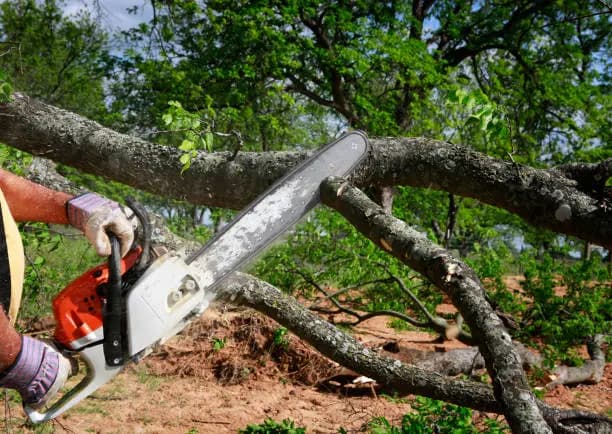
tree-service worker cutting a large branch from an elevated position

Sources used on this page

Government, university, and public-agency references below support local rules, forestry guidance, storm history, and other factual context used on this page.

Trimming & pruning questions

When is the best time to prune trees in Georgia?

For most deciduous trees, the late-dormant season — approximately late November through February — is the preferred window. February is often considered the sweet spot: branch structure is visible, disease and insect pressure is low, and the tree's spring energy surge drives vigorous wound closure.

When should I NOT prune an oak tree in Georgia?

Avoid pruning oaks from approximately February through June to reduce the risk of transmitting oak wilt through beetle vectors that are active in that window. Deep dormancy — November through January — is the safest time to prune oaks.

Is topping a tree a good way to reduce its size?

No. Topping — indiscriminate heading cuts to shorten a tree — is broadly recognized as the most harmful common pruning practice. It produces weakly attached regrowth and long-term decay, and typically increases rather than decreases long-term failure risk. Proper crown reduction by a certified arborist uses selective cuts back to lateral branches to preserve the tree's natural form.

How often should I prune a mature tree?

Cycles of roughly every two to five years are typical for mature residential trees, depending on species, growth rate, and objectives. Younger trees benefit from more frequent structural pruning in their first 15 years.

Does Woodstock require a permit to remove a tree?

Yes, for any tree three inches diameter at breast height or greater within the City of Woodstock. Diameter at breast height is measured 4.5 feet above the ground. The permit is free, but it is capped at five non-specimen trees per residential lot per calendar year. Even dead or dying trees require an approved permit.

What are the penalties for removing a tree in Woodstock without a permit?

Fines are paid to the Tree Preservation Fund based on the Land Development Code fee schedule. Violations are misdemeanors, and convictions may carry fines up to $1,000 per offense or up to six months imprisonment. Each day of continued violation may be considered a separate offense.

What qualifies as a specimen tree in Woodstock?

Specimen tree criteria depend on species. Tulip poplar, sweet gum, river birch, silver maple, or pine at 30 inches diameter at breast height or greater; ash, beech, blackgum, cedar, cypress, hickory, magnolia (excluding bigleaf), maple (excluding silver), pecan, persimmon, redwood, sourwood, sycamore, or walnut at 24 inches diameter at breast height or greater; American holly, dogwood, redbud, or bigleaf magnolia at criteria determined by the city arborist.

Is there a Woodstock urban tree canopy plan?

Yes. The Georgia Forestry Commission published an Urban Tree Canopy Assessment for the City of Woodstock in March 2024, identifying strategies for tree preservation, code audits, staff training, "Right Tree, Right Place" public education, and formalizing the city's tree board.

Start your tree trimming & pruning request in Woodstock

Tell CanopyFind what you need, where the property is, and when you need help.

Start a service request