CanopyFind

Tree Trimming & Pruning in Kennesaw, GA

For a tree trimming & pruning request in Kennesaw, start with the local rule, the tree and site conditions, and the exact scope you want a provider to evaluate. The sections below combine Kennesaw-specific context with practical tree trimming & pruning guidance.

Explain the outcome you want rather than asking for an arbitrary amount removed.

Ask how the proposed cuts support the tree’s structure and health.

arborist climbing a ladder to prune a mature tree in a residential yard

Start your tree trimming & pruning request

Choose the tree work that applies and tell us where the property is. You can add details in the next step.

Services Select all that apply

Submitting a service request does not book a job.

Tree Trimming & Pruning in Kennesaw: local factors first

Kennesaw's tree-cutting permit is aimed at removal rather than routine private-property pruning, although Historic District work can require additional review depending on scope. Established lots commonly include mature oaks, tulip poplars, and pines, and the Georgia Forestry Commission notes elevated Southern Pine Beetle risk in pine stands during drought years.
Storm exposure

Historic railroad and downtown structures in Kennesaw's core add proximity risk when mature street trees fail.

University of Georgia Cooperative Extension resource

Cobb County Extension Office (shared with Marietta and other Cobb cities).

How to frame tree removal in Kennesaw

A residential removal in Kennesaw is more than cutting a trunk at ground level. The scope normally covers dismantling or felling the tree, processing brush and wood, and cleaning the work area; stump grinding is commonly a separate line item. Tight access or a canopy over structures can shift the method toward sectional rigging, bucket work, or crane support. Condition should drive the decision. Strong reasons for removal include advanced decline, serious trunk defects, substantial crown loss, root instability, an increasing lean toward a target, or an untreatable Emerald Ash Borer infestation in an ash.

Definition and scope

"Tree trimming" and "tree pruning" are often used interchangeably in everyday conversation. In arboriculture, "pruning" refers more strictly to structural or health-driven cuts guided by the American National Standards Institute A300 tree care standard, and "trimming" often refers to aesthetic or clearance work. Both should be performed with clean, properly targeted cuts. Neither should ever involve "topping" — indiscriminate heading cuts to shorten a tree. Topping is broadly recognized as the most harmful common pruning practice; it produces weakly attached regrowth and long-term decay, and typically increases rather than decreases long-term failure risk.

Best timing for the region

For most deciduous trees in Georgia, the late-dormant season — approximately late November through February, with February often considered the sweet spot — is the preferred pruning window. Dormant-season pruning offers three advantages: branch structure is visible without foliage; fungal and insect pressure on fresh wounds is lower in cold conditions; and the tree can direct its spring energy surge into vigorous wound closure.

Oaks carry a particularly important timing rule: avoid pruning oaks from roughly February through June to reduce the risk of transmitting oak wilt through beetle vectors that are active in that window. Deep dormancy (November through January) is the safest window for oaks.

Exceptions to the dormant-season rule

Key points for tree trimming & pruning include the following practical considerations.

  • Hazard removal is time-independent. Broken, cracked, dead, or diseased limbs that pose a risk should be removed as soon as they are identified, regardless of season.
  • Spring-flowering ornamentals (dogwoods, redbuds) are typically pruned just after they finish flowering, to preserve the next year's bloom.
  • Summer light pruning for small deadwood or clearance is acceptable, but major structural cuts should generally wait for dormancy.

Common Trees Found on Residential Properties

Native and naturalized species commonly found on residential lots across northwest Georgia, according to University of Georgia Cooperative Extension resources, include:

  • Oaks: white oak, southern red oak, willow oak, water oak, black oak, chestnut oak
  • Pines: loblolly pine, shortleaf pine, Virginia pine, eastern white pine (at higher elevations)
  • Hickories: mockernut, pignut, shagbark
  • Other hardwoods: tulip poplar (yellow poplar), sweetgum, red maple, silver maple, black gum, American beech, sycamore, river birch, black walnut, pecan
  • Understory and flowering: dogwood, redbud, American holly, sourwood, southern magnolia, bigleaf magnolia
  • Cedars and evergreens: eastern red cedar; Leyland cypress (planted, not native)

Certifications and How Providers Are (Not) Regulated in Georgia

Georgia does not license or certify arborists at the state level. Certified arborists in Georgia are credentialed through the International Society of Arboriculture, a private professional body. This makes independent credential verification important when choosing a tree service.

According to the Georgia Forestry Commission, before hiring a tree company homeowners should:

The American National Standards Institute A300 standard defines proper tree care work in the United States. The American National Standards Institute Z133 standard covers safety in tree care operations. Reputable providers can identify these standards on request.

  • Verify that the provider carries current general liability insurance and workers' compensation insurance, and confirm each policy is active by calling the insurance carrier directly.
  • Request written estimates that include credentials, scope of work, and cost breakdown.
  • Ask for references and, when possible, visit finished work.
  • Never allow climbing spikes to be used on trees being pruned (spikes are appropriate only for trees being removed, because the puncture wounds create long-term decay pathways).
  • Be cautious of "drive-by tree service" — an unmarked truck and a chainsaw are not a credential.

What helps a provider assess the service request

This page combines the service and location without pretending to know the property. Add real site details in the service request flow.

01

Dead or damaged limbs are present

02

Branches are too close to a roof, driveway, or other structure

03

A young tree needs structural guidance

04

Dense growth is creating a specific clearance concern

Use the property—not generic local claims

CanopyFind does not publish an assumed provider price, availability window, or credential for Kennesaw. Property-specific details should be confirmed for the actual job.

Read the complete trimming & pruning guide

Before you compare options

  • Explain the outcome you want rather than asking for an arbitrary amount removed.
  • Ask how the proposed cuts support the tree’s structure and health.
  • Confirm how debris and cleanup will be handled.
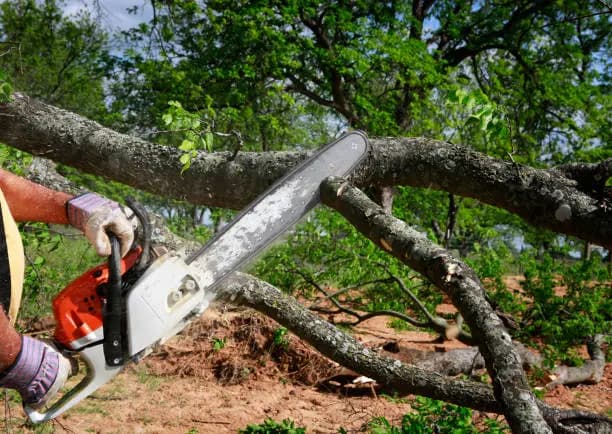
tree-service worker cutting a large branch from an elevated position

Sources used on this page

Government, university, and public-agency references below support local rules, forestry guidance, storm history, and other factual context used on this page.

Trimming & pruning questions

When is the best time to prune trees in Georgia?

For most deciduous trees, the late-dormant season — approximately late November through February — is the preferred window. February is often considered the sweet spot: branch structure is visible, disease and insect pressure is low, and the tree's spring energy surge drives vigorous wound closure.

When should I NOT prune an oak tree in Georgia?

Avoid pruning oaks from approximately February through June to reduce the risk of transmitting oak wilt through beetle vectors that are active in that window. Deep dormancy — November through January — is the safest time to prune oaks.

Is topping a tree a good way to reduce its size?

No. Topping — indiscriminate heading cuts to shorten a tree — is broadly recognized as the most harmful common pruning practice. It produces weakly attached regrowth and long-term decay, and typically increases rather than decreases long-term failure risk. Proper crown reduction by a certified arborist uses selective cuts back to lateral branches to preserve the tree's natural form.

How often should I prune a mature tree?

Cycles of roughly every two to five years are typical for mature residential trees, depending on species, growth rate, and objectives. Younger trees benefit from more frequent structural pruning in their first 15 years.

Do I need a permit to remove a tree in Kennesaw?

Yes. The City of Kennesaw requires a tree cutting permit for residential tree removal. The permit fee is $25.00, submitted to the Kennesaw Public Works Department at 3080 Moon Station Road.

What extra requirements apply in Kennesaw's Historic District?

Properties in the Kennesaw Historic District require Historic Preservation Commission approval and an additional $50 Certificate of Appropriateness fee, for a total of $75 in permit fees.

How long is a Kennesaw tree cutting permit valid?

Six months from the date of issuance. Do not begin cutting until the permit has been issued.

Who is responsible for cleanup after tree removal in Kennesaw?

The property owner. The permit terms specify that the owner handles all cleanup and debris removal, and that the work must minimize impact on city streets and not interfere with garbage pickup.

Start your tree trimming & pruning request in Kennesaw

Tell CanopyFind what you need, where the property is, and when you need help.

Start a service request