CanopyFind

Tree Trimming & Pruning in Acworth, GA

For a tree trimming & pruning request in Acworth, start with the local rule, the tree and site conditions, and the exact scope you want a provider to evaluate. The sections below combine Acworth-specific context with practical tree trimming & pruning guidance.

Explain the outcome you want rather than asking for an arbitrary amount removed.

Ask how the proposed cuts support the tree’s structure and health.

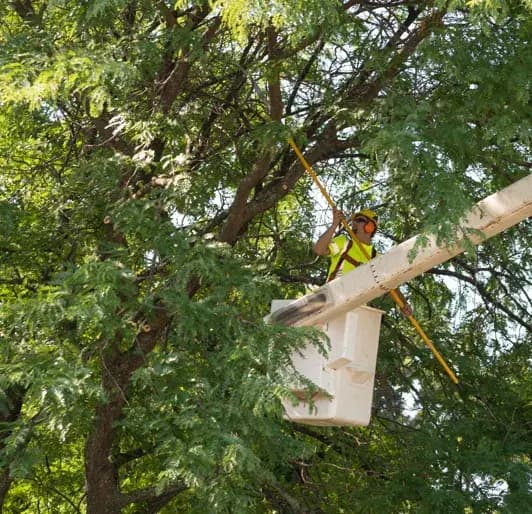
arborist climbing a ladder to prune a mature tree in a residential yard

Start your tree trimming & pruning request

Choose the tree work that applies and tell us where the property is. You can add details in the next step.

Services Select all that apply

Submitting a service request does not book a job.

Tree Trimming & Pruning in Acworth: local factors first

Routine pruning of private-property trees generally does not trigger Acworth's Tree Removal Permit requirements. Pruning as part of a landscape plan compliance obligation or protected-zone maintenance may. Cypress, river birch, and sycamore along Lake Acworth and Lake Allatoona shorelines have specific timing and technique considerations that differ from upland oaks and pines. Waterfront tree management under Georgia's riparian-buffer rules and U.S. Army Corps of Engineers Lake Allatoona regulations may govern shoreline pruning. Homeowners should confirm before any major work near the water.
Municipal tree ordinance — Acworth has a formal Tree Ordinance (last amended May 2, 2024)

The Acworth Tree Ordinance is part of Chapter 73 of the City of Acworth Zoning Ordinance and Chapter 98 (Vegetation) of the Code of Ordinances. Permit trigger: A Tree Removal Permit is required when a person applies for another permit that necessitates tree removal — for example, a building permit or a land disturbance permit. Contractor licensing and insurance: All tree removal permit activity must be conducted by a company properly licensed to do business in the State of Georgia carrying a minimum insurance coverage of $500,000 per incident and general liability coverage of up to $2,000,000 per incident. This is a distinctive Acworth requirement. Land Disturbance Permit: Required for defoliation or alteration of a site or commencement of land-disturbing activities. Issued by the Department of Public Works. Protected Zones: Include all lands outside the buildable area of a parcel, lands required to remain green space, and required landscape strips and buffers. Removal from Protected Zones is limited. Specimen trees: Defined as trees determined to be of high value due to species, size, age, or other criteria. Specimen tree preservation earns additional consideration. Central Business District: Certain provisions do not apply to properties within the Central Business District.

Local tree canopy character

Acworth's lakeside geography introduces waterfront tree management considerations that inland cities do not share: shoreline erosion control, protected riparian buffer trees, and cypress and river birch along Lake Acworth and Lake Allatoona shorelines. Upland residential canopy includes typical Piedmont oak-pine-hickory species — loblolly pine, white oak, southern red oak, tulip poplar, red maple, sweetgum. Lake Allatoona and Lake Acworth also mean higher density of docks, sheds, and lakeside structures near mature trees.

Define the pruning objective before work starts

A useful trimming request in Acworth starts by describing the result you need, not by asking to 'cut the tree back.' Arboricultural pruning can remove hazards, improve young-tree structure, raise lower branches, thin density, or reduce crown size through lateral cuts. Wholesale topping is harmful and should not be confused with professional crown reduction.

Choose timing by species and urgency

An Acworth pruning schedule should account for species and urgency. Dormant-season work from late fall through winter is generally preferred for many deciduous trees because the crown is visible and wound exposure occurs during lower pest pressure. Planned oak pruning is best moved away from roughly February through June. Broken, cracked, dead, or dangerous limbs remain an exception and can require immediate removal.

What proper pruning should look like

Evaluate the cuts, not just the amount of debris on the ground. Correct pruning preserves the branch collar, avoids stubs and flush cuts, and limits live-canopy loss on mature trees. The Georgia Forestry Commission specifically warns against using climbing spikes on a tree that is being pruned rather than removed. Those details are useful questions to put into the written scope.

How to interpret a pruning quote

Large mature trees cost more to prune because crews spend more time climbing, rigging, lowering limbs, and protecting the site. Across metro Atlanta, many residential pruning jobs fall between about $150 and $800, while complex large-hardwood work can reach roughly $1,800 or more. A written scope should say whether cleanup, hauling, and any cabling or support work are separate.

Definition and scope

"Tree trimming" and "tree pruning" are often used interchangeably in everyday conversation. In arboriculture, "pruning" refers more strictly to structural or health-driven cuts guided by the American National Standards Institute A300 tree care standard, and "trimming" often refers to aesthetic or clearance work. Both should be performed with clean, properly targeted cuts. Neither should ever involve "topping" — indiscriminate heading cuts to shorten a tree. Topping is broadly recognized as the most harmful common pruning practice; it produces weakly attached regrowth and long-term decay, and typically increases rather than decreases long-term failure risk.

Best timing for the region

For most deciduous trees in Georgia, the late-dormant season — approximately late November through February, with February often considered the sweet spot — is the preferred pruning window. Dormant-season pruning offers three advantages: branch structure is visible without foliage; fungal and insect pressure on fresh wounds is lower in cold conditions; and the tree can direct its spring energy surge into vigorous wound closure.

Oaks carry a particularly important timing rule: avoid pruning oaks from roughly February through June to reduce the risk of transmitting oak wilt through beetle vectors that are active in that window. Deep dormancy (November through January) is the safest window for oaks.

What helps a provider assess the service request

This page combines the service and location without pretending to know the property. Add real site details in the service request flow.

01

Dead or damaged limbs are present

02

Branches are too close to a roof, driveway, or other structure

03

A young tree needs structural guidance

04

Dense growth is creating a specific clearance concern

Use the property—not generic local claims

CanopyFind does not publish an assumed provider price, availability window, or credential for Acworth. Property-specific details should be confirmed for the actual job.

Read the complete trimming & pruning guide

Before you compare options

  • Explain the outcome you want rather than asking for an arbitrary amount removed.
  • Ask how the proposed cuts support the tree’s structure and health.
  • Confirm how debris and cleanup will be handled.
tree-service worker pruning branches high in a residential tree

Sources used on this page

Government, university, and public-agency references below support local rules, forestry guidance, storm history, and other factual context used on this page.

Trimming & pruning questions

When is the best time to prune trees in Georgia?

For most deciduous trees, the late-dormant season — approximately late November through February — is the preferred window. February is often considered the sweet spot: branch structure is visible, disease and insect pressure is low, and the tree's spring energy surge drives vigorous wound closure.

When should I NOT prune an oak tree in Georgia?

Avoid pruning oaks from approximately February through June to reduce the risk of transmitting oak wilt through beetle vectors that are active in that window. Deep dormancy — November through January — is the safest time to prune oaks.

Is topping a tree a good way to reduce its size?

No. Topping — indiscriminate heading cuts to shorten a tree — is broadly recognized as the most harmful common pruning practice. It produces weakly attached regrowth and long-term decay, and typically increases rather than decreases long-term failure risk. Proper crown reduction by a certified arborist uses selective cuts back to lateral branches to preserve the tree's natural form.

How often should I prune a mature tree?

Cycles of roughly every two to five years are typical for mature residential trees, depending on species, growth rate, and objectives. Younger trees benefit from more frequent structural pruning in their first 15 years.

Does Acworth require a tree removal permit?

Acworth's Tree Ordinance (last amended May 2, 2024) requires a Tree Removal Permit when another permit — such as a building or land disturbance permit — triggers tree removal. Owner-occupied single-family lots outside protected zones and outside another permit action have a simpler path, but should confirm with Acworth Development Services before removal.

What insurance must my Acworth tree removal contractor carry?

Under Acworth's Tree Ordinance, any company performing tree removal permit activity must be licensed in Georgia and carry a minimum insurance coverage of $500,000 per incident, with general liability that covers the property for up to $2,000,000 per incident.

Are there special considerations for lakeside trees in Acworth?

Yes. Trees within required riparian buffers, protected zones, or shoreline setback areas may be subject to additional protection. Federal U.S. Army Corps of Engineers regulations on Lake Allatoona may also apply near the water. Confirm with Acworth Development Services before shoreline work.

Is Acworth in the same hardiness zone as the rest of metro Atlanta?

Under the U.S. Department of Agriculture's 2023 Plant Hardiness Zone Map update, Cobb County is in Zones 8a to 8b. Acworth falls in this range.

Start your tree trimming & pruning request in Acworth

Tell CanopyFind what you need, where the property is, and when you need help.

Start a service request