CanopyFind

Tree Trimming & Pruning in Cartersville, GA

For a tree trimming & pruning request in Cartersville, start with the local rule, the tree and site conditions, and the exact scope you want a provider to evaluate. The sections below combine Cartersville-specific context with practical tree trimming & pruning guidance.

Explain the outcome you want rather than asking for an arbitrary amount removed.

Ask how the proposed cuts support the tree’s structure and health.

arborist climbing a ladder to prune a mature tree in a residential yard

Start your tree trimming & pruning request

Choose the tree work that applies and tell us where the property is. You can add details in the next step.

Services Select all that apply

Submitting a service request does not book a job.

Tree Trimming & Pruning in Cartersville: local factors first

Private-property pruning in Cartersville does not require a city tree permit. Historic districts contain mature trees that may warrant coordination when visible work intersects preservation concerns, and oak pruning is generally best scheduled during deep dormancy rather than the higher-risk February-through-June window.
Storm exposure

Cartersville shares the broader severe-weather pattern seen across northwest Georgia. The area is served from the Georgia Forestry Commission's Mountain District Office in Cartersville — (770) 387-4900 — which coordinates land-clearing burn permits and regional forestry response for a wide swath of North Georgia counties.

University of Georgia Cooperative Extension resource

Bartow County Extension Office serves Cartersville.

How to frame tree removal in Cartersville

In Cartersville, a useful removal estimate should describe the whole operation: how the tree will be dismantled, what happens to brush and trunk sections, how nearby property will be protected, and whether stump grinding is part of the price. Open yards and constrained backyards can require very different methods even for trees of similar size. Homeowners should separate hazard indicators from appearance concerns. Extensive dead crown, major cracks or cavities, lifting roots, serious lean, and advanced decline are stronger removal signals than ordinary deadwood or an oversized crown. For ash trees showing Emerald Ash Borer attack, the Georgia Forestry Commission's guidance supports removal after infestation; for otherwise sound trees, pruning may still be the better option.

What good pruning looks like

Cuts are made just outside the branch collar — not flush with the trunk and not leaving stubs. Typically no more than 25% of live canopy is removed in a single season on mature trees. According to the Georgia Forestry Commission, climbing spikes should never be used on trees being pruned; they are appropriate only for trees being removed, because the puncture wounds create long-term decay pathways. Wound dressings are generally not recommended except in specific oak wilt vector windows.

Cost expectations for metro Atlanta

Market ranges span $150 to $500 for typical residential trimming and pruning, with $800 to $1,800 or more for large hardwoods such as mature oaks that require rigging and multi-person crews. Arborist hourly rates in the metro typically run $100 to $250 per hour with a one-hour minimum. As with removal, cost is driven primarily by tree size, access, complexity, and disposal.

Why professional pruning matters more on mature trees

Structural pruning on a young oak or maple during the first 15 years of its life is one of the highest-return arboricultural investments a homeowner can make — it establishes canopy architecture that resists storm failure for decades. Corrective pruning on a mature tree that was topped or poorly pruned decades earlier is much more limited in what it can achieve and is more expensive per cycle.

Climate & Growing Conditions

Northwest Georgia spans both the northwest side of metropolitan Atlanta and the Ridge and Valley region.

Under the U.S. Department of Agriculture's 2023 Plant Hardiness Zone Map update, Cobb, Cherokee, and Bartow counties fall in Zones 8a–8b, meaning the average annual extreme minimum temperature runs between 10°F and 20°F. This is a half-zone warmer than the 2012 map, which placed much of the area in Zone 7b–8a. Floyd County (Rome) sits at the transition between the Piedmont and the Ridge and Valley region, generally Zone 7b–8a.

The regional climate is humid subtropical: hot summers, mild winters, and precipitation distributed through the year.

Common Trees Found on Residential Properties

Native and naturalized species commonly found on residential lots across northwest Georgia, according to University of Georgia Cooperative Extension resources, include:

  • Oaks: white oak, southern red oak, willow oak, water oak, black oak, chestnut oak
  • Pines: loblolly pine, shortleaf pine, Virginia pine, eastern white pine (at higher elevations)
  • Hickories: mockernut, pignut, shagbark
  • Other hardwoods: tulip poplar (yellow poplar), sweetgum, red maple, silver maple, black gum, American beech, sycamore, river birch, black walnut, pecan
  • Understory and flowering: dogwood, redbud, American holly, sourwood, southern magnolia, bigleaf magnolia
  • Cedars and evergreens: eastern red cedar; Leyland cypress (planted, not native)

Pruning objectives for mature residential trees

A pruning plan should be tied to a specific objective rather than simply reducing the amount of canopy. Crown cleaning removes dead, diseased, broken, or weakly attached branches; crown thinning selectively reduces density and wind sail without changing the tree’s overall size; crown raising creates clearance below the canopy; and structural pruning improves branch architecture while trees are still developing. For established Cartersville properties, that distinction matters because a mature tree can often be preserved when the work focuses on defective branches and long-term structure instead of indiscriminate cutting. Topping is not a substitute for proper pruning. It leaves large heading cuts, stimulates weakly attached regrowth, and can increase long-term decay and failure risk.

What helps a provider assess the service request

This page combines the service and location without pretending to know the property. Add real site details in the service request flow.

01

Dead or damaged limbs are present

02

Branches are too close to a roof, driveway, or other structure

03

A young tree needs structural guidance

04

Dense growth is creating a specific clearance concern

Use the property—not generic local claims

CanopyFind does not publish an assumed provider price, availability window, or credential for Cartersville. Property-specific details should be confirmed for the actual job.

Read the complete trimming & pruning guide

Before you compare options

  • Explain the outcome you want rather than asking for an arbitrary amount removed.
  • Ask how the proposed cuts support the tree’s structure and health.
  • Confirm how debris and cleanup will be handled.
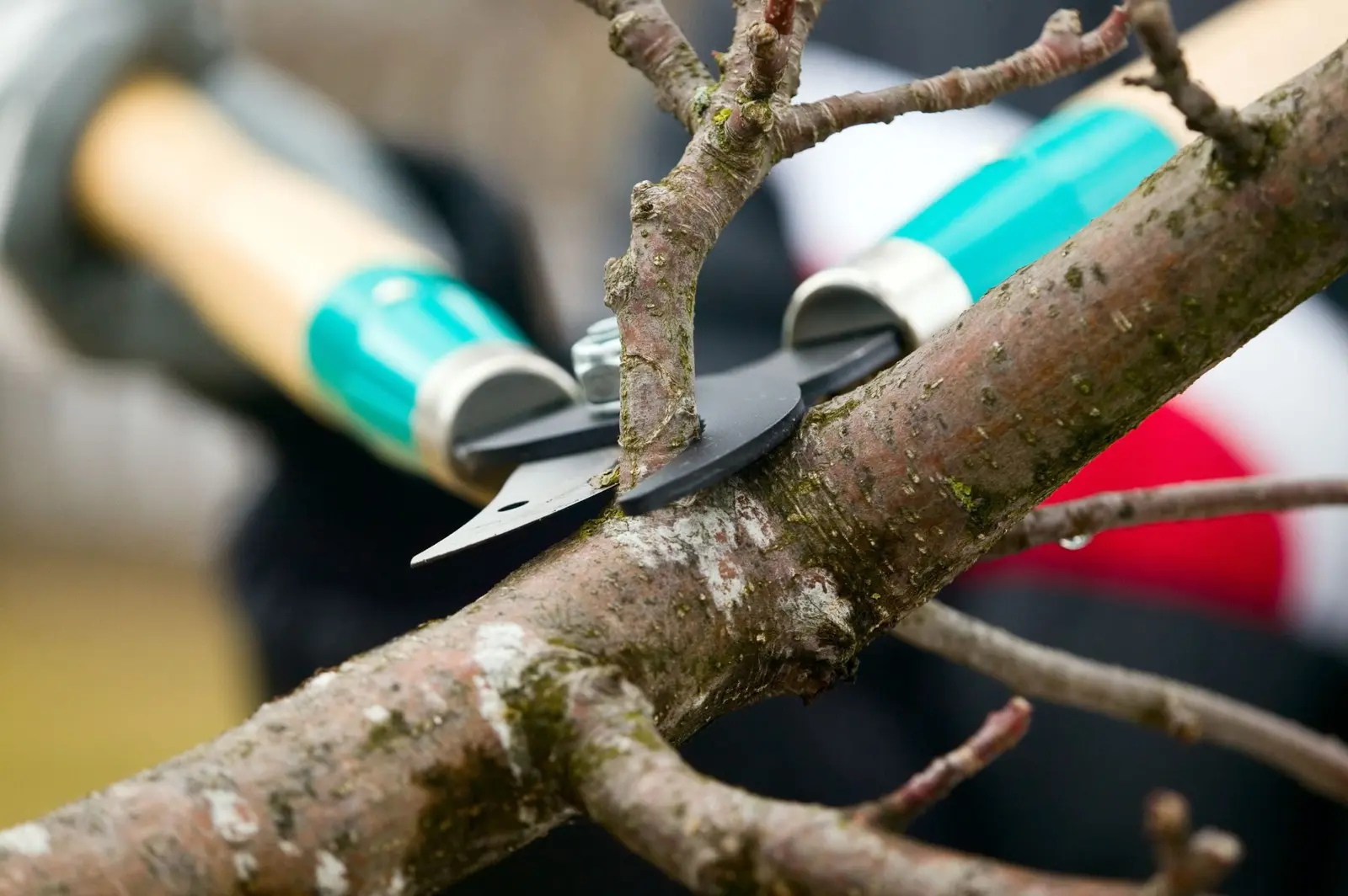
hand pruning a small tree branch with bypass shears

Sources used on this page

Government, university, and public-agency references below support local rules, forestry guidance, storm history, and other factual context used on this page.

Trimming & pruning questions

When is the best time to prune trees in Georgia?

For most deciduous trees, the late-dormant season — approximately late November through February — is the preferred window. February is often considered the sweet spot: branch structure is visible, disease and insect pressure is low, and the tree's spring energy surge drives vigorous wound closure.

When should I NOT prune an oak tree in Georgia?

Avoid pruning oaks from approximately February through June to reduce the risk of transmitting oak wilt through beetle vectors that are active in that window. Deep dormancy — November through January — is the safest time to prune oaks.

Is topping a tree a good way to reduce its size?

No. Topping — indiscriminate heading cuts to shorten a tree — is broadly recognized as the most harmful common pruning practice. It produces weakly attached regrowth and long-term decay, and typically increases rather than decreases long-term failure risk. Proper crown reduction by a certified arborist uses selective cuts back to lateral branches to preserve the tree's natural form.

How often should I prune a mature tree?

Cycles of roughly every two to five years are typical for mature residential trees, depending on species, growth rate, and objectives. Younger trees benefit from more frequent structural pruning in their first 15 years.

Does Cartersville require a tree removal permit?

No. The City of Cartersville states that a permit is not required for tree removal or pruning. The one exception: trees removed that were included on a landscape plan, as part of approved development plans, must be replaced.

What is the exception to Cartersville's no-permit rule?

Trees included in an approved development plan's landscape plan must be replaced if removed. This applies most often in newer subdivisions and commercial properties where trees were counted toward landscape plan compliance at approval.

Is there a state forestry office in Cartersville?

Yes. The Georgia Forestry Commission's Mountain District Office is based in Cartersville at (770) 387-4900. It coordinates land-clearing burn permits and regional forestry response for Bartow, Catoosa, Chattooga, Cherokee, Cobb, and other North Georgia counties.

What hardiness zone is Cartersville in?

Under the U.S. Department of Agriculture's 2023 Plant Hardiness Zone Map update, Bartow County falls generally in Zone 8a.

Start your tree trimming & pruning request in Cartersville

Tell CanopyFind what you need, where the property is, and when you need help.

Start a service request